
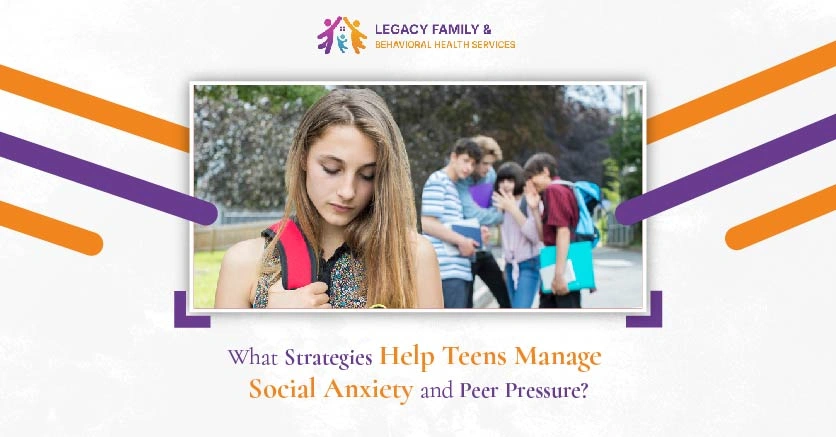
Middle school and high school ask a lot of a developing brain.
Fit in without blending in too much. Speak up without saying the wrong thing. Make friends without looking like you’re trying too hard. If a teen already runs anxious, that math doesn’t work before first period even starts.
It’s more common than most parents realize, and it usually doesn’t just fade with age. NIMH data puts lifetime social anxiety disorder at roughly 9 percent of adolescents between 13 and 18, and higher for girls than boys. Most people who ever develop social anxiety first notice it somewhere in childhood or the teen years, which is exactly why this age range matters so much for getting real support in place early.
Why This Age Hits So Hard
A few things stack up during adolescence that make social anxiety more likely to show up now than at almost any other point in life.
Peer approval starts to matter in a way it never has before. A teenage brain is genuinely wired to track social standing closely during this stretch. That’s normal development, but it also means embarrassment or rejection lands harder than it would for a younger kid, or for an adult who’s had years to build up some perspective.
School doesn’t do anyone any favors here either. Reading aloud, presenting to the class, sitting somewhere visible at lunch, all of it can become a real source of dread when you’re already anxious, since so much of the school day involves being watched and judged in one way or another.
And peer pressure layers right on top. Wanting to belong is completely normal. For a teen already dealing with anxiety, that pull can turn into agreeing to things that feel wrong, staying quiet when something actually needs to be said, or avoiding a situation entirely because standing out feels like more than they can handle.
Two Ways Teens Cope With This, and They’re Not Equal
Research on how teens handle peer stress draws a useful distinction between two general coping styles.
One is engaged in coping, actually facing a stressful situation head on. Working through the anxious feeling, thinking it through more realistically, taking some kind of direct action. The other is disengaged coping, avoiding the situation altogether by pulling back, distracting, or shutting down.
Even though teens who rely on avoidance do feel relief in the moment, avoidance does not help the anxiety go away over time. Research on socially anxious adolescents has specifically shown these people tend to opt for this avoidant style, which just goes in a cycle of creating more social difficulty later on rather than solving anything.
That is absolutely the trap that perpetuates social anxiety. Not going to class presentations is more enjoyable that day. It also tacitly reinforces an anxious brain’s notion that the presentation was something to dread which will only make the next one much harder to deal with.
What Genuinely Helps
The following are the approaches with some science supporting their use to help teens develop a coping style that stands the test of time.
One of the best-established treatments successfully used for anxiety in teens is cognitive behavioral therapy. It trains someone to take note of the automatic negative thoughts, stop and see if those thoughts are true, and then practice doing a different thing other than rewinding that same anxious tape over and over again. Not just talking someone out of how they feel in that moment, but instead building a different habit underneath the anxiety even if it takes repetition.
By breaking the avoidance cycle directly, by arranging gradual exposure to feared social situations, rather than stumbling into them. Programs that guide teens through this sort of practice, starting small and gradually increasing the challenge level, have been shown to provide tangible benefit in decreasing social anxiety and the symptoms of depression that regularly accompany it.
Practicing actual interpersonal skills matters just as much as managing the anxious feeling internally. Clear “I feel” statements, picking a reasonable moment to bring something up, rehearsing an awkward conversation ahead of time through role play, these give a teen something concrete to reach for instead of just white knuckling through the discomfort.
Group settings and peer support tend to help more than people expect. Sitting with other teens working through similar anxiety, in a setting that’s actually structured and supportive, normalizes the experience in a way that reassurance from one adult often can’t quite match.
Relationships outside a formal treatment setting can play a real role too. Research on teens with strong bonds to their dogs has found these relationships may help buffer social stress and support more adaptive coping, likely through some combination of emotional comfort and a calmer physical stress response. It’s a reminder that support for this doesn’t only come from a therapist’s office.
What Parents Can Actually Do
Watching a teen struggle with this makes most parents want to step in and fix it immediately, and that instinct, understandable as it is, can sometimes reinforce the exact avoidance pattern that’s keeping the anxiety alive.
Letting a teen skip every uncomfortable situation feels protective in the short term. Over time, it tends to quietly confirm the belief that these situations really are too much to handle. A more useful role for a parent is helping a teen work up to hard situations gradually, with real support alongside them, rather than removing the situation from their life altogether.
Naming the pattern out loud tends to help too. A teen who understands that avoidance offers short term relief but feeds the fear over the long run has actual language for what’s happening inside them, which makes the whole experience feel less confusing and a lot less like a personal failing.
And it helps to recognize when this needs more support than what’s available at home. If social anxiety is affecting school attendance, friendships, or everyday functioning, that’s worth taking seriously now rather than waiting to see if it resolves on its own.
What This Looks Like at Legacy Family BHS
Finding support for a teen struggling with social anxiety typically begins by uncovering their individual triggers, instead of using blanket anxiety frameworks on every scenario.
From there, treatment can combine proven approaches like CBT and gradual exposure with real, practical skill building suited to the actual social situations a teen is facing day to day.
Whether your teen is facing an issue related to friendships, classroom pressure or the pull of the herd mentality – this is something worth a candid conversation with someone who knows how to help sort through that.
Legacy Family BHS can help build a plan around what your teen actually needs.
Reach out to schedule an appointment.