
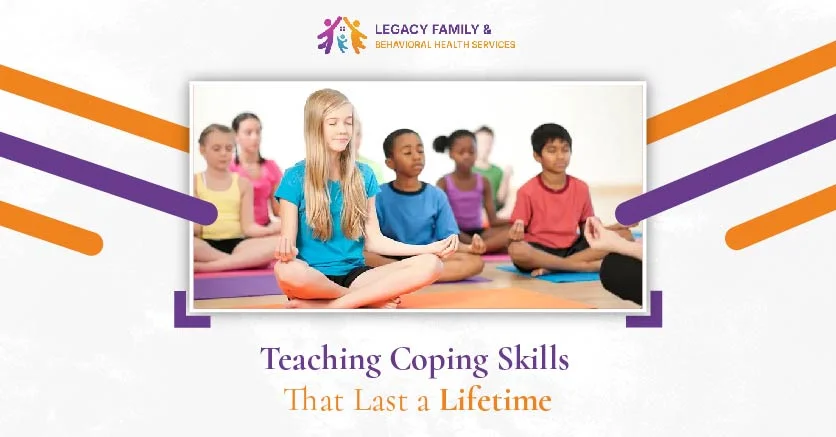
Kids don’t come knowing how to handle stress. Honestly, nobody really does.
It’s a skill. Like any skill, it gets built through practice, usually long before it’s actually needed.
Most people learn coping the hard way, mid-crisis, with nothing underneath them. Teaching it early changes that.
The Timing Matters More Than People Realize
The best time to teach a coping skill isn’t during a meltdown. It’s on some random Tuesday when nothing’s even wrong.
Try explaining deep breathing to a kid mid-tantrum and watch it go nowhere. The brain’s too flooded in that moment to learn anything new.
Skills taught calmly, then practiced over and over, are the ones that actually show up later when things get hard. Not the ones pulled out as a last resort in the moment.
Naming The Feeling Comes First
A kid can’t manage something they can’t name. Sounds obvious, but it’s easy to skip past.
Helping a child put a word to what’s happening, frustrated, scared, overwhelmed, comes before any actual tool makes sense. A kid who can say “I’m frustrated” has already done something a kid who’s just screaming hasn’t.
This takes modeling more than instruction. Naming your own feelings out loud in front of your kid teaches it faster than any worksheet.
Breathing And Body-Based Tools
Kids respond well to physical tools, mostly because their bodies are usually way ahead of their thinking in a stressful moment.
Simple breathing helps. Counting breaths. Something visual, like pretending to blow out candles slowly, works better for younger kids than an abstract instruction to “calm down.”
Movement matters too. A walk, some jumping jacks, squeezing something. Anything that gives the extra energy somewhere to go instead of just sitting there.
Solving The Problem, Not Just Calming Down
Calming down is only half the job. The other half is figuring out what to do once the feeling’s settled a little.
Breaking a problem into smaller pieces helps here. What’s actually wrong. A couple options. What happens if one gets tried first.
Coping isn’t just surviving a hard feeling. It’s learning that hard feelings usually come with something you can actually do about them, even something small.
Kids Learn By Watching, Not By Being Told
If a parent handles frustration by yelling, that’s the real lesson. Doesn’t matter what gets said afterward about using your words.
Nobody manages every hard moment gracefully, and that’s fine. What helps is narrating the recovery out loud.
“I got really frustrated just now, so I’m going to take a breath before I respond.” One sentence like that teaches more than a dozen conversations about coping in the abstract.
A Few Tools Work Better Than One
No single coping skill works for every kid, every time. A small toolbox usually beats one go-to strategy.
Some kids need something physical. Others need quiet and space. Some want to talk it out right away, others need time before they’re ready to talk at all.
Letting a kid pick their own tools, instead of handing down a fixed list, tends to make things stick. Ownership matters more than people think here.
Practicing While Things Are Calm
Coping skills work like any other skill. Ignored until needed, they’re shaky. Practiced regularly, they hold.
Small, low-stakes moments help build that. Before bed. After a hard day at school. Just checking in at dinner. Low pressure, real repetition.
That repetition is what actually makes the difference later, when there’s no time to figure it out from scratch.
When Extra Support Helps
This is one of those things where some kids will need more scaffolding than others — especially when trauma, continuous anxiety or larger challenging behavior fit in the mix.
No one is to blame for the failure.
And by that, it means the building skill needs more than what occurs on its own in a house.
If your family could use some extra support here, the team at Legacy Family Behavioral Health Services can help build coping skills that actually hold up, not just in the moment they’re taught.