
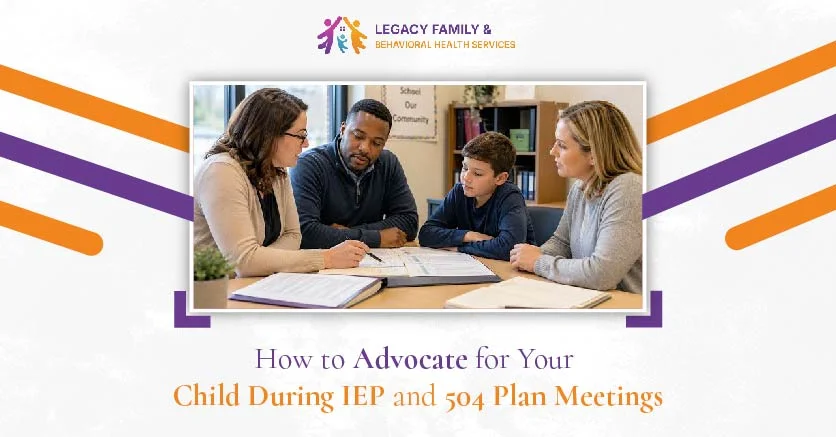
There’s no manual for this. One day you’re sitting at a table hearing terms like FAPE and LRE thrown around.
You have a pile of paperwork in front of you that sounds like it was drafted for an attorney somewhere out front.
Feeling lost in that room doesn’t mean you’re doing anything wrong. Most people across that table want the plan to work.
But the system moves faster for people who already know the language. Most parents are learning it in real time.
Figure Out Which Plan You’re Actually In
People use IEP and 504 plan like they’re the same thing. They’re not and the difference matters.
An IEP comes from a federal special education law called IDEA.
- A child needs one of thirteen specific disability categories to qualify
- The disability has to actually affect their ability to learn
- IEPs can include specialized instruction built around that specific child
A 504 plan comes from a different law, Section 504, a civil rights law.
- No need for one of those thirteen categories
- Just a disability that substantially limits a major life activity
- Usually covers accommodations like extra time or seating changes – not specialized teaching
Knowing which one you’re in front of changes how the conversation goes! Asking for specialized instruction under a 504 plan is asking the wrong office for the wrong thing.
Read the Paperwork Before the Meeting
Schools send documents ahead of time. Evaluation reports, draft goals, proposed services.
A lot of parents skim this the morning of. Some see it for the first time once they’re already seated.
Reading it slowly beforehand changes the meeting. Questions get asked instead of absorbed and forgotten.
There’s no scramble trying to process new information while also speaking up for your kid at the same time.
Write Down What’s Happening at Home
Teachers see a slice of the day. Parents see the rest of it.
A few examples of what’s worth writing down:
- The meltdown after school nobody at school ever sees
- Homework that takes three hours instead of thirty minutes
- A stomachache that shows up every single test day
Get Agreements in Writing
Things said out loud in a meeting tend to disappear by the time the document gets drafted.
If a service or accommodation gets agreed on, ask for it in writing before the meeting ends.
This isn’t about assuming bad faith. It’s just how these systems work.
Plans get written by people juggling dozens of kids. Good intentions get lost in the shuffle if they’re not pinned down on paper.
“I Need More Time” Is a Complete Sentence
There’s pressure in these meetings to agree on the spot because everyone else seems ready to wrap up. That pressure isn’t real.
You’re allowed to pause. Take everything home. Come back before signing anything.
Disagreeing is allowed too, and it doesn’t need a speech. “I don’t think this goal reflects what we’re seeing at home” is enough on its own.
The team’s job is to work through that, not move past it because the meeting is running long.
Bring Backup if the Room Feels Too Big
You’re allowed to bring someone. A few options:
- An advocate
- A therapist
- A family member or friend
- Anyone who can help process what’s happening in real time
This doesn’t mean treating the school like an opponent. One parent against five professionals isn’t a fair setup, and there’s nothing wrong with evening that out.
Ask What Happens Next, Specifically
A meeting that ends on a vague feeling things will improve isn’t the same as a meeting that ends with an actual plan.
Before leaving, ask a few direct questions:
- What exactly is changing
- When does it start
- Who is responsible for each piece
- How will progress actually get measured and shared
Without that clarity, months can pass with nothing visibly different. There’s often no clear point where anyone checks back in.
You Don’t Have to Walk In Alone
Understanding a child well enough to advocate for them in a room full of professionals is part of the work at Legacy Family Behavioral Health Services.
That might mean making sense of an evaluation. It might mean prepping for a meeting. It might mean just having clear documentation of what’s actually happening day to day.
What happens on the outside of that building often tends to make the inside of that meeting a lot less overwhelming.
If an upcoming IEP or 504 meeting feels like more than you want to face alone then reach out .