
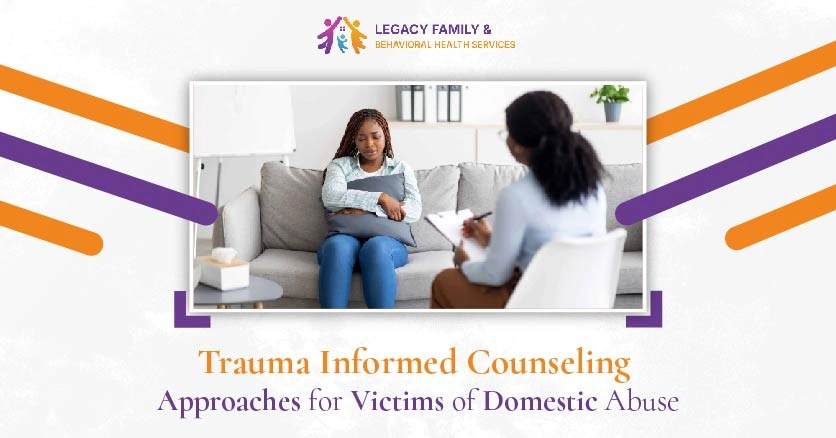
Someone leaving an abusive relationship doesn’t just walk away with bad memories.
And they leave with a nervous system that had been trained for years to remain in red alert. An argument, an angry voice, the bang of a door or even just an expression across the table can set off a reaction that has nothing to do with logic.
Regular talk therapy doesn’t always account for that. Trauma informed counseling starts from a different place entirely, built around what abuse actually does to a person, not just the events themselves.
Where Standard Therapy Can Fall Short
Most traditional therapy assumes a certain baseline of trust and safety the moment someone walks in the door.
For a survivor of abuse, that assumption doesn’t always hold. Trust has often been weaponized against them. Safety hasn’t been reliable for a long time, sometimes years.
Research on domestic violence support programs has found survivors regularly running into services that end up retraumatizing them without meaning to. A provider pushing for details too fast. A rigid intake process that feels controlling. A tone that lands as judgment instead of support.
Nobody’s doing this on purpose. It still hurts the same either way.
Trauma informed care exists specifically to close that gap.
Trauma Informed Isn’t the Same as Trauma Specific
People use these terms like they’re interchangeable. They’re not.
Trauma informed care is the overall approach. It shapes how a counselor talks, how a room is set up, how choices get offered from the very first phone call through every session after.
Trauma specific work is the actual technique used to treat trauma symptoms directly, things like EMDR or trauma focused CBT. A trauma informed environment is basically what makes that specific work possible in the first place. Skip the first piece and the second one usually doesn’t stick.
What Good Care Actually Looks Like Session to Session
A handful of principles keep showing up across the research on domestic violence care, and they turn into real, specific things a counselor does differently.
Safety isn’t a box checked once at intake. It’s checked constantly. Where someone sits. Whether the door’s in view. Whether a question feels like a real question or an interrogation dressed up as one.
Control gets handed back on purpose. Abuse strips a person’s sense of agency away slowly, over time, in ways that add up. A trauma informed counselor works against that pattern deliberately, offering options instead of instructions, asking instead of assuming, letting the survivor set the pace on how much gets shared and when.
Connection to other people gets built into treatment, not left to happen on its own. Isolation is one of the most common tools an abuser uses, and reconnecting to trusted people, family, friends, a support group, tends to be part of the actual plan rather than an afterthought.
New coping tools get built without shaming the old ones. Someone coming out of years of abuse likely relied on habits that kept them safe at the time and don’t serve them anymore. A good counselor helps replace those without treating them like a failure.
A survivor’s actual life gets taken into account, not just their symptoms. Cultural background, immigration status, sexuality, financial situation, all of it shapes what safety and recovery even look like for that specific person. Ignore that context and a framework tends to fail exactly the people it wasn’t built with in mind.
And resilience gets named out loud. Someone survived ongoing abuse, which already took real strength. Good care builds on that instead of treating the person as a list of symptoms to fix.
The Numbers Behind Why This Matters So Much
The scale of domestic violence in this country is hard to look past.
CDC survey data shows more than one in three women and more than one in six men experience contact sexual violence, physical violence, or stalking from an intimate partner at some point in their lives. A study looking specifically at people seeking help from domestic violence services found more than three quarters scored above the clinical threshold for PTSD, alongside high rates of depression and anxiety.
That’s not a small group of people dealing with mild stress. That’s a population carrying serious trauma, often walking straight into services that weren’t necessarily built with that in mind.
What It Actually Feels Like as a Survivor
Often a first session with a trauma informed counselor has a very different feel than would an intake appointment.
Less pressure to recount everything that happened right away.
More attention paid to how the session’s actually landing, checking in as things go, making sure the person in the room has real say over how it unfolds. Nothing rushed toward someone else’s idea of progress.
The nature of physical safety planning typically goes right in hand with the emotional work, particularly for someone who is managing separation, custody or housing instability.
A wise counselor treats them as part of the whole.
Group support sometimes fits in too. Sitting in a carefully run room with other survivors can ease the isolation abuse tends to leave behind.
If You’re in Danger Right Now
Counseling is just part of a whole healing process and not an emergency solution.
If you or someone you know is in danger, the National Domestic Violence Hotline can be reached 24/7 at 1-800-799-7233, or via text by texting START to 88788.
What This Looks Like at Legacy Family BHS
Healing from abuse doesn’t move in a straight line, and it shouldn’t be treated like it does. Care here is built around safety, real choice, and a pace that actually respects what someone’s lived through, not a timeline that belongs to somebody else.
If you’re navigating life after an abusive relationship and looking for support that meets you where you actually are, Legacy Family BHS can help build a plan around what you need right now. Reach out to schedule a consultation.